
Alexandra | 4/22/2024
This post mentions two therapists that have helped our son. Please note that I have changed the actual names of the therapists and have given them aliases to protect their privacy and identities. Also note that I am not a professional — my suggestions are just suggestions, and are not professional recommendations.
If you’re new here, welcome! I’m part of a neurodiverse family; we all dibble and dabble and have our own forms of neurodivergence that come with their own individual sets of challenges. Our son, who has autism, has been experiencing a moderate speech delay. His ability to understand the speech of others is very high — actually, it’s higher than average for children his age. But his ability to find words and speak them for himself is low.
When we enrolled him in speech therapy, we received tons of help and learned a great bit about our little dude’s cognitive functions. One of the biggest things we learned is that he’s hyperlexic, meaning that he can read extremely well, though he may not be able to process the meaning behind the words he reads. We also learned that he is a gestalt language processor and primarily communicates using echolalia.
Echolalia is something that almost all children utilize at some point. It’s essentially just copying words and phrases that they hear as they’re learning to speak. Echolalia itself is completely typical. Our son’s exclusive use of it well into his toddler years is what drew concern during his initial speech evaluation and ultimately led to him receiving speech therapy regularly.
About halfway through his first set of therapy visits, our son’s regular therapist, Carmen, mentioned that our son was great at making observations during play. He would frequently say little phrases about things he would see while playing. “It’s a car!” “Oh, a swing!” But we knew that we’d have to expand his vocabulary to communicate beyond making observations. Carmen knew that because of his exclusive use of echolalia to communicate, our son’s vocabulary expansion would likely have to come in the form of phrases rather than individual words. Makes sense.
Carmen used play to teach him different phrases while allowing him to remain active. This strategy usually worked consistently for the first few minutes of the visit and somewhat sporadically until the end of the appointment. Our son would usually get so caught up in playing that he would just stop speaking completely or would only say his usual couple of phrases: “Oh no! Let’s try again” and “Runnnnn!”
Carmen would usually give him new words to use by building onto the phrases he already knew: “On no. Let’s try the swing again” or “I like to runnnnnn!” Her strategy was helpful, but really only worked if our son was actively listening — which he typically wasn’t when he was indulged in play. So he naturally hit a wall that we were having trouble breaking through for a while.
Enter Ashley.
Ashley was the speech therapist assigned to our son during his second set of therapy appointments. She happened to also be neurodivergent and was able to provide a different approach to therapy because of her unique connection to autism. Ashley’s strategy was to give him more individual words to interchange, which was kinda related to Carmen’s strategy but with more of a focus on the individual words themselves rather than the phrases they were part of. And she also ensured that these words were taught in a way that encouraged him to sit and focus on one thing at a time. Ashley made the connection between our son’s hyperlexia and his love for play — something I’d never even thought to do — in the most ingenious way. I firmly believe that this strategy is what pushed him over from a level 1 processor to a level 2 in a matter of weeks. What did she do?
Two words. Smash mats.
But what are they? Well, smash mats are just that — mats that you can smash! Well, smash stuff onto. Because you don’t smash the mat itself.
Anyway, a smash mat is just a piece of card stock with words and phrases printed on it, preferably with some short of shape around them. Ashley’s mats were organized by type and difficulty. So she had verb mats, noun mats, simple phrase mats, and so many others.
The “smash” comes into play by taking some of your kiddo’s favorite Play-doh, rolling it up into balls, and sitting them to the side. Sit with your kiddo and point to the pictures on the mat, asking them to tell you what you’re pointing at. As they say what they are, put the Play-doh on the word and — you guessed it — have your scholar SMASH THE BALL! Use whatever you have on hand; Ashley had my little dude use a toy hammer, but we’ve used his palm, the bottom of empty cups, even small plastic figurines! Whatever would make smash mats super fun for you guys.
They’re so simple but so helpful when it comes to teaching words and phrases. There are tons of benefits to using these ingenious mats, but here are my top three:
Built-in rewards
Unlike other learning methods that require you to come up with some sort of incentive, these smash mats have built-in rewards. I mean, what kid doesn’t like finding ways to smash or break stuff? Play-doh is already seen by kids as a toy — so using it constructively can easily make a mundane task into a fun game!
Easy clean up and portability
Play-doh is washable and non-toxic, making it perfect for kids. There’s also ways to make edible versions of the putty at home — even better for our friends who like to chew on their toys 😉 When it’s time to wrap things up, just throw the clay back into the container, put the mats away, and go! If you laminate your sheets (or keep them covered in some sort of plastic), you can just wipe the mats clean with a moist paper towel to clear off the Play-doh crumbs and store them away for next time. Done!
These mats also travel very well. Dollar Tree has really small containers of Play-doh that are perfect for learning on flights and long car rides. Slap the mat onto a clipboard or another flat surface and go crazy!
Super versatile and easy to customize
The best part about these mats is that they can grow with your kiddos’ needs. Want to focus less on words and more on math? Want to teach colors? Want to learn the names of planets? Need to match famous authors with their literature? Make some smash mats! Smash mats are so versatile and can be extremely helpful for learners of all ages — if I’d had these while I was in college, maybe I wouldn’t have dreaded studying nearly as much 😉
Download the ‘Tism Things smash mat template for free! Use our 8-slot template to write in your own words or phrases, paste in pictures, or draw out shapes for your learner to smash!
Not feeling crafty? We’ve done the work for you! Head over to The Shop by ‘Tism Things and buy our smash mat sets linked below! We offer a variety of options to suit your learner’s needs; with 7 different sets (and counting!), there’s something for almost everyone. Purchase a digital copy and start smashing today!
I hope these smash mats prove to be as helpful for you and yours as they were for me and mine. If you’ve used smash mats, share your experience with them below!
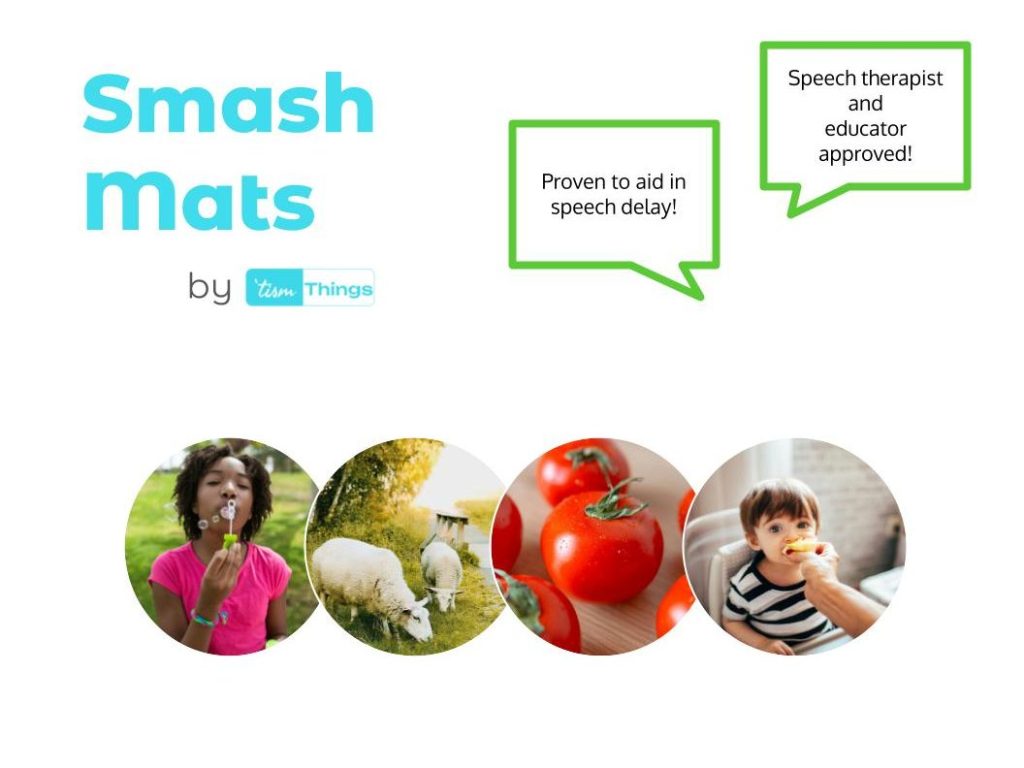
‘Tism Things Smash Mats
Starting at $5.99
Choose from 7 different mats, bundle them all and save!
- Active Little People
- Early Readers
- Just Getting Started – 1
- Just Getting Started – 2
- Little Mathematicians
- What’s on My Plate?
- The World Around Us
About the Author

Alexandra is the founder of the ‘Tism Things platform and owner of online business The Shop by ‘Tism Things. A proud stay-at-home wife and mama to two amazing, smart, and empowered littles, Alexandra frequently spends her time learning about autism and ADHD, its effects on families and caregivers, and ways to support individuals with either or both conditions. Driven by her son and husband’s autism and ADHD diagnoses, Alexandra prides herself on employing creative methods to adapt her household into one that welcomes people of all neurological types, aiming to foster a sense of inclusivity, understanding and acceptance among anyone’s path she crosses.
When she’s not in a ’tism rabbit hole on the internet or playing with her babies, she’s likely out shopping, cooking something yummy, helping out her grandparents, or out in the garden trying to keep her plants alive in this Georgia heat. Honestly, probably that last one.
 'Tism Things Blog
Sound off!